Cutting through the noise
Key lessons from cloud transformations in Banking.
A primer for leaders.
PwC CEE, in collaboration with Rubin Worldwide, analyzed an international peer group of over 30 leading global banks to understand and evaluate the scale of cloud adoption within the Financial Service industry.
The aim of the study was not just to measure the average number of workloads on the cloud. In our analysis, we directly searched for the “business effect” of the cloud and, if found, what were the key factors behind it. As such, we started with a hypothesis that banks with a high level of cloud adoption are also more efficient businesses. We looked at various metrics: overall profitability, cost-effectiveness, IT-generated value, and IT performance.
The results were split. Firstly, they revealed that cloud adoption does not automatically mean bottom-line improvement. Some businesses perform well, while still at the early stage of their cloud journey. However, most importantly, we also discovered a group of banks that outperform the rest. We found that among the advanced cloud adopters, the most efficient businesses are those that realize a mature cloud strategy. We have called such
organizations the “Cloud leaders”.
Our study revealed that “Cloud leaders” are 20% more profitable and 10% more cost-efficient than the “laggards”. They also run more efficient and scalable IT areas. In this material, we explore how they do it. We go beyond the marketing slogans that surround “cloud transformation” and apply lessons learned together with our clients to propose what a “mature” cloud strategy looks like. We also suggest key questions that should be addressed when creating one. With that, we aim to cut through the “noise” and share pragmatic advice for banking leaders, globally.

Przemysław Paprotny
Partner, CEE Financial Services Leader PwC Poland

Mariusz Chudy
Partner, CEE Cloud & Digital Leader PwC Poland

Jed Rubin
Principal and Director of Operations for EMEA and Asia Pacific, Rubin Worldwide

Przemysław Galiński
Director, CEE Cloud & Digital PwC Poland
x
“Cloud leaders” spend on average over 5x more on cloud than the “laggards”; their cloud strategies are also more “mature”
%
“Cloud leaders” are 20% more profitable and 10% more cost efficient
%
Achieving 40% of workloads on cloud may take 2-3 years and cost about 10-20% of annual IT cost base
%
“Cloud leaders” generate 13% more revenue from the same value of IT spend and are 2x quicker (provisioning time) and 3x more reliable (number of critical incidents).
Eight key interconnected trends are disrupting the Banking market
Key trends disrupting the banking market
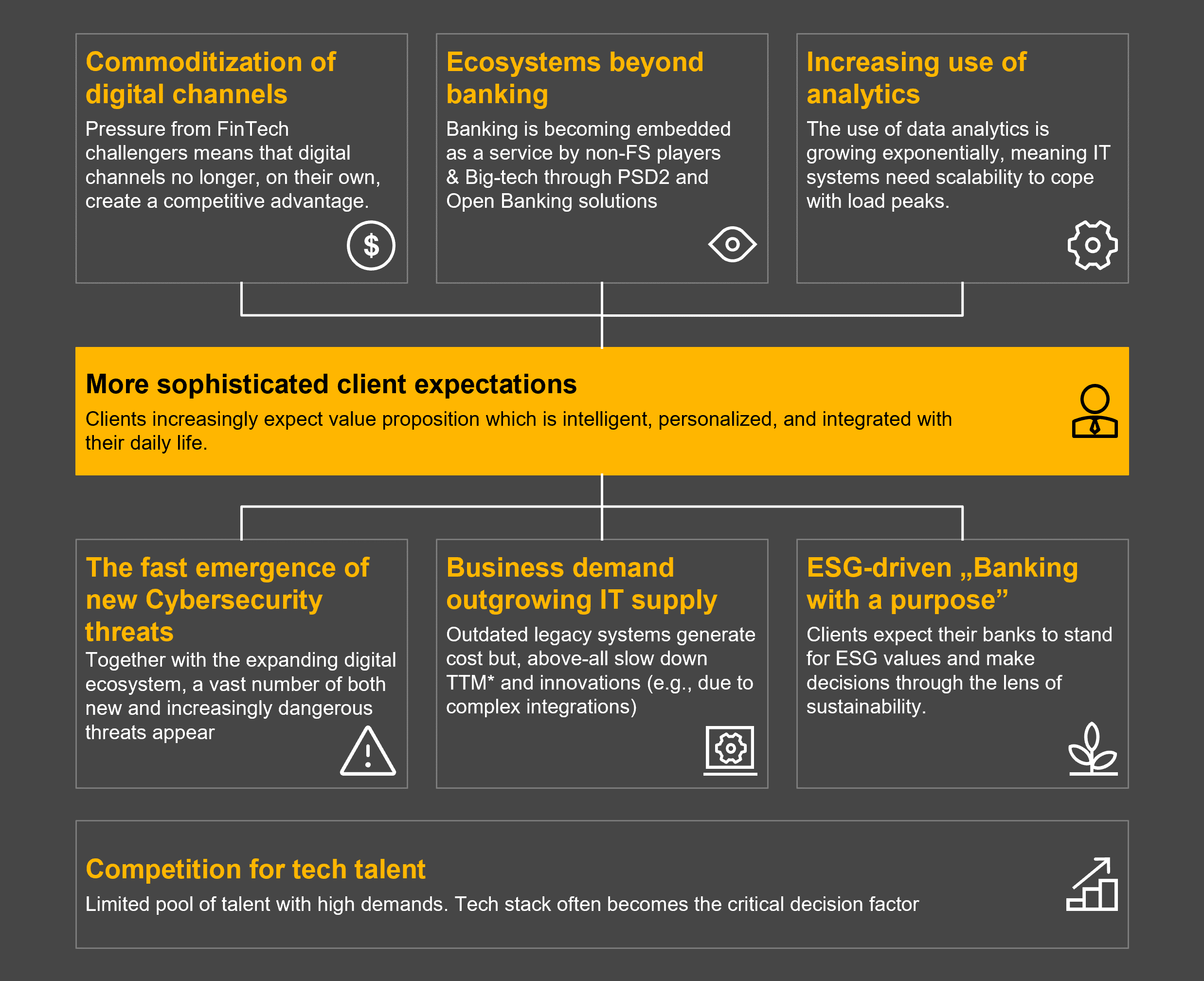
Even though the topic is technology, the two underpinning layers are people - clients and employees. The decisions regarding the technology must be made through those lenses.
In a practical sense, it means that Banks must ask themselves - what value can be offered to those stakeholders. In the case of clients, the growing sophistication is driving more personalization. It works with a great technology stack for employees (tech talent).
The meeting of both of the above needs can be enabled by cloud computing.
Cloud adoption unlocks benefits beyond
cost-savings
Cloud benefits overview
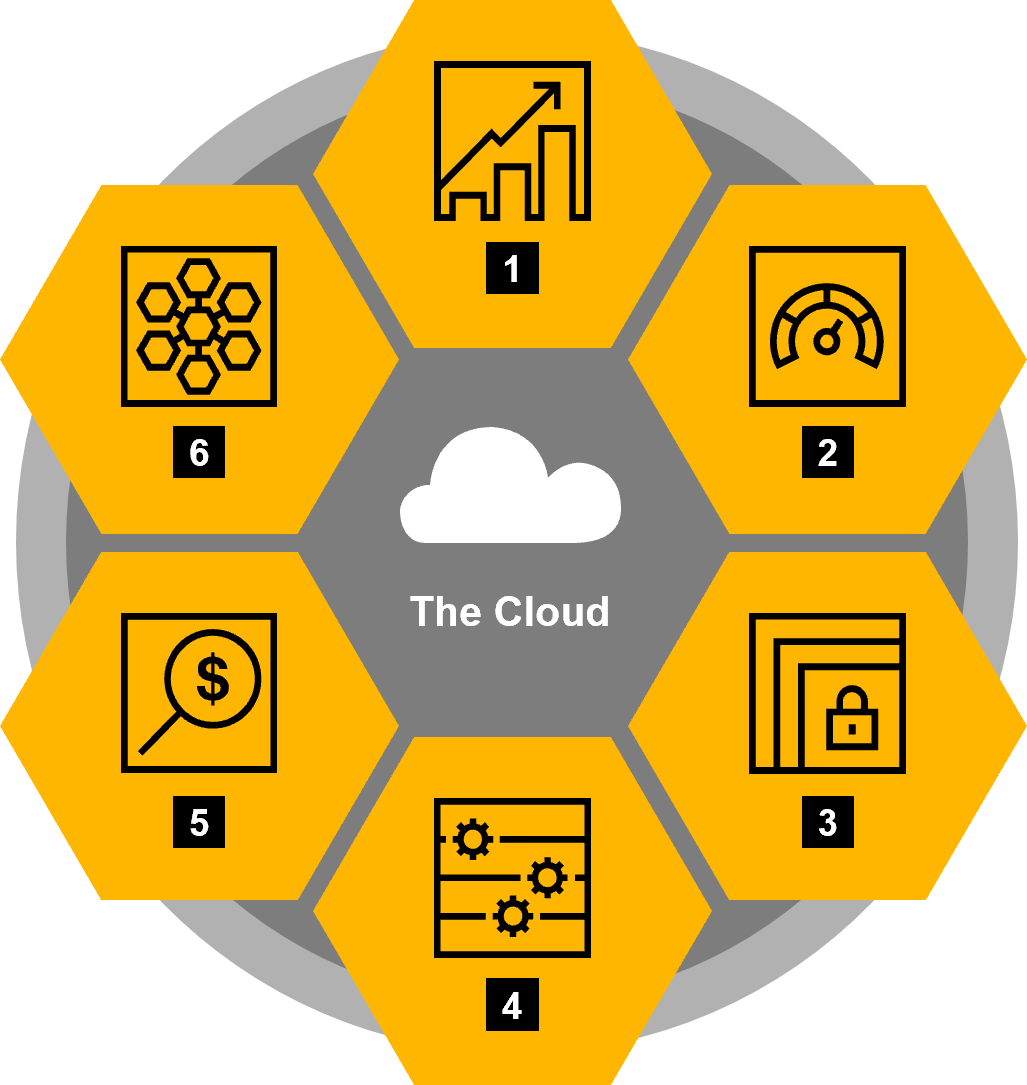

Unlimited scalability - Instantly provisioned infrastructure at near unlimited scale, applications use as much or as little computing and storage

Performance, speed & agility - Going from quarterly or monthly releases to releasing code multiple times a day as they need and pay for only what they use.

Security & Compliance - Secure migration is a challenge, however the right cloud-native solutions ultimately ensure higher Cybersecurity

ESG efficiency - Reduction of energy & carbon footprint. Supporting ESG transformation through digital and cloud transformation.

Cost control - Cost reduction vs on-prem in the mid/long-term driven by the scale, limited over-provisioning and faster dev. process & operations

Plug & Play innovations - New offerings are being introduced all the time allowing us to leverage the latest tech, immediately
The true value of cloud is not cost savings. Cost savings in the range of +20% typically concern large organizations with multiple legacy data centers which undergo consolidation and termination. In the case of leaner organizations, the cost savings exists once the scale is built, but it’s in the lower digits.
However, the cloud’s actual value lies in enabling both business growth and sustainability targets while typically ensuring a higher degree of security.
How to connect Business and Cloud strategy?

Cloud has become the foundation that enables businesses to transform, differentiate and gain competitive advantage.
Organizations have moved past asking whether applications can be deployed or migrated to the cloud. Instead, they are commonly accepting the pace and innovation of cloud providers as the foundation of their business
However, by implementing one-off or short-sighted cloud solutions — often at the urging of the IT area — many companies have failed to realize the financial benefit, innovation potential, and ecosystem value cloud platforms provide. Only strategic, business-driven decisions involving cloud computing will enable companies to become fast, resilient, and adaptable in the emerging business environment
A successful Cloud strategy needs to be a group effort, aligned with Enterprise business strategy, goals, and outcomes, and also a living document that is updated as the organization's digital assets and goals evolve
Cutting through the noise
Key lessons from cloud transformations in Banking. A primer for leaders.
The report “Cutting through the noise” is dedicated and available only for institutional and corporate clients. PwC reserves the right to select applications and refuse to accept applications, especially in the case of registration of persons representing entities conducting competitive activity.
* Required fields
** PwC Advisory spółka z ograniczoną odpowiedzialnością sp.k. or another PwC entity (list of entities), with its registered seat in Warsaw (00-633), Polna 11 Street will be the controller of your personal data. The data will be processed for the purpose of sending out the publication. A full information about processing your personal data is available in our Privacy Policy.
*** PwC Advisory spółka z ograniczoną odpowiedzialnością sp.k. or another PwC entity from which you receive commercial information (list of entities), with its registered seat in Warsaw (00-633), Polna 11 Street will be the controller of your personal data. The data will be processed for the purpose of direct marketing through sending commercial information to you via email or phone. A full information about processing your personal data is available in our Privacy Policy.
You have the right to withdraw your consent at any time by sending an email to pl_privacy@pwc.com. Moreover, every marketing communication from PwC will contain an option to resign from subscribing to the newsletter.
Przemysław Galiński